OHM SWEET OHM: A SIMPLE GUIDE TO SPEAKER IMPEDANCE
If you've ever shopped for speakers or hooked them up to an amplifier, you've probably seen numbers like 4 ohms, 6 ohms, or 8 ohms listed on the back of your speaker or in its manual. These numbers refer to impedance, which is a term that might sound technical or intimidating, but is actually pretty simple once you break it down.
In the world of audio, understanding impedance is important because it helps ensure your amplifier and speakers work well together. Matching the right impedance not only helps protect your gear but also ensures you’re getting the best possible sound.
In this guide, we explain what speaker impedance is, how it affects your audio setup, and how to choose components that play nicely together. Whether you’re setting up your first home theater or just curious about how it all works, this guide is for you!
WHAT IS SPEAKER IMPEDANCE?
Wait - are we here to learn about speaker impedance or speaker ohms? Both, actually! They travel hand-in-hand. This is because speaker impedance is measured in ohms (Ω). It determines how much electrical current a speaker takes from an amplifier. Most speakers you'll run into are 8 ohms; 4-ohm speakers are common as well.
Speaking of current…let’s imagine this as water. More specifically, let’s picture a water slide. The electrical current is the water, while the speaker’s impedance is the slide, meaning it controls how much water (current) is let through. The wider the slide, the more the current flows.
Low impedance is that wider water slide; a speaker with low impedance draws more electrical current from the amplifier, allowing the amp to send more power to the speaker. However, a slide that’s too wide and has too much water can be dangerous for someone like a small child. In the same way, a low-impedance speaker is a bad match for an amplifier that’s not designed to handle the load.
High impedance, on the other hand, is a thinner slide that allows less water to flow down it, meaning it draws less current from the amp. This reduces the strain on the amplifier, which makes it easier to drive. However, just like a thin slide wouldn’t make a very good water slide for adults, a high-impedance speaker wouldn’t be the best fit for all amps. In some cases, higher impedance speakers have to ask your amp for a higher voltage to hit the same volume level as on a lower impedance.
UP HIGH VS DOWN LOW

So, low impedance vs high impedance! Which is better? Actually, neither one is really superior to the other. Speaker impedance doesn’t directly impact a speaker’s quality. It depends on your system’s needs.
Low-impedance speakers draw more current, delivering greater power and louder sound - if the amplifier can handle it. Amps that aren’t capable of handling the increased current run the risk of issues such as overheating. But if they are, low impedance is great for immersive music and movie experiences.
High-impedance speakers draw less current, which means they need a higher voltage to achieve the same volume and power output at the same settings as low-impedance speakers. However, they do put less of a strain on the amplifier, making them more ideal for longer-lasting environments and continuous use.
WHY IT’S IMPORTANT
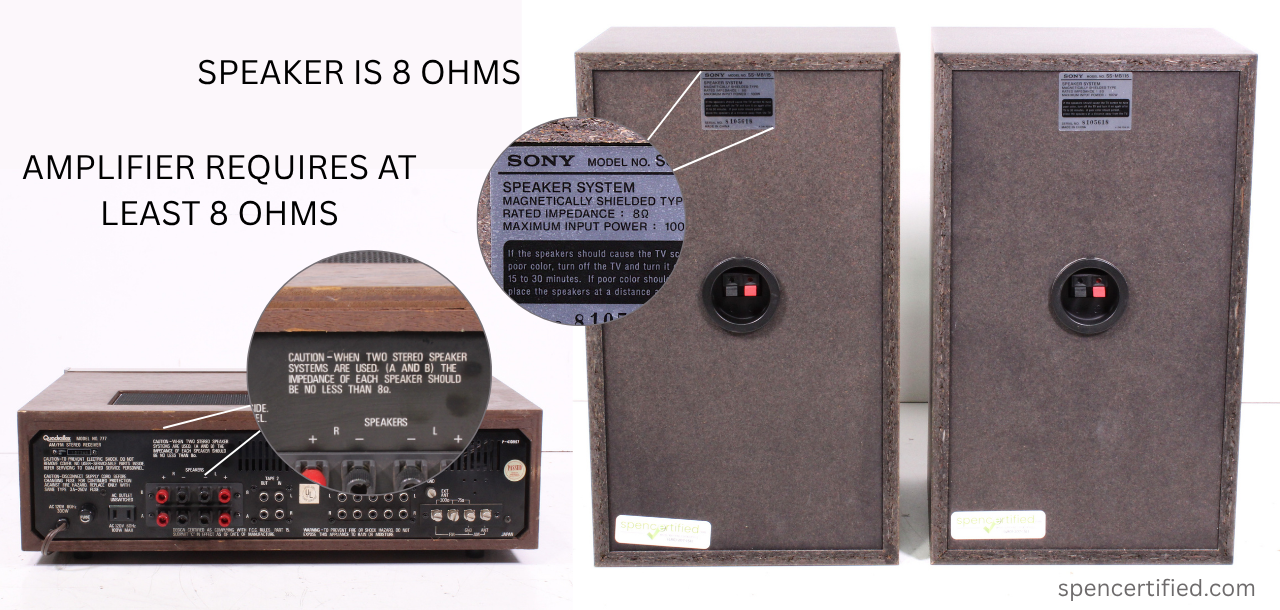
Particularly when it comes to vintage equipment, getting your speaker impedance to match your amplifier is important. When they match, your audio will be clean, clear, and crisp; when they don’t, your music can sound weak and strained. It ensures your speaker, amp, and the rest of your components work together so you get the best sound possible.
It’s also important to match speaker impedance to speaker impedance. If you’re creating a home theater system, getting speakers with compatible impedance will let them work smoothly as one so your home is filled with that uniform, balanced sound you expect from a theater setup.
SIDE NOTE: Speaker impedance is something you only have to worry about with passive speakers, which are speakers that require an external amp. If you purchase active speakers, which have built-in amps, the impedance is managed internally.
KEEP IN MIND…

It’s also important to remember that the speaker impedance is a nominal value. Without getting too technical, this means that a speaker’s impedance curves will, in reality, typically differ from their given ohm value. Many other properties impact how a speaker sounds. However, speaker impedance is still an important guideline when shopping for speakers, as it helps you match them to an amplifier that can properly drive them.
IN SUMMARY
Matching makes perfect in the realm of speaker impedance. Bringing your sound to life is the ultimate goal of speaker setups. And matching the impedance (8 ohms, 6 ohms, 4 ohms, etc.) to your amplifier’s requirements is the first step in making your audio system happy and healthy.
Thanks for reading! If you’re interested in checking out the speakers we have available, you can view them here. Have a great day!
https://spencertified.com/collections/home-stereo-speakers




Comments
Leave a comment