WHAT MAKES SPEAKERS SPEAK: UNDERSTANDING SPEAKER DRIVERS
When you push that play button on your cassette deck or you drop that needle onto vinyl, it’s easy to forget the complex journey that sound takes before reaching your ears. At the heart of that journey lies a crucial but often overlooked component: the speaker driver. From 7.2-channel home theater systems to high-end stereo systems, it's the drivers doing the heavy lifting by transforming electrical signals into the rich, clear audio you enjoy.
And if you’re a casual music listener, chances are you haven’t given much thought to the components that make up your tower and bookshelf speakers. And a term like “speaker driver” is actually pretty misleading. That’s why we’re going to break down exactly what a speaker driver is, how it works, and why it plays such a vital role in the performance of any sound system.
Whether you're new to audio tech or just looking to understand your gear better, this guide will help you get to the core of what makes speakers speak.
WHAT IS A SPEAKER DRIVER?
A speaker driver is a speaker. Simple as that, right?
Actually, it’s a little more complicated. The speaker driver differs from the speaker itself. The speaker is what we call the whole package; this includes the cabinet, the crossovers, the padding, the port tube, and the speaker drivers.
The speaker driver is the individual component that is responsible for creating the sound waves you hear. The electrical pulses from your source (like a CD player) and amplifier get converted into sound waves that are emitted through the driver.
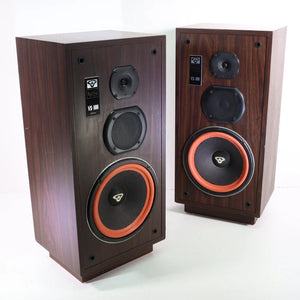
Most speakers have at least two drivers, and many have more than that. Drivers are different sizes depending on their purpose as their shape affects how they reproduce specific ranges of sound. Larger ones handle the low bass while the smaller ones take care of the high-pitched frequencies. We’ll go into more detail on this later.
HOW IT WORKS
The purpose of the speaker driver is the same purpose behind the speaker itself: to create sound. Since it converts the electrical signals from your amp into physical sound waves, you’re able to hear your music. Without the driver, there would be no sound.
So it works the way any transducer does, which is to say that it converts one type of energy into another. The electrical signal flowing from your amp creates a magnetic field, which causes the driver to vibrate back and forth. The vibration is what causes those sound waves that your ears register as sound.
ANATOMY OF A DRIVER
In order to interpret the electrical signals and translate them into sound waves, there are several components that need to work together. Here’s an overview of each main specialized component:
-
Wire Terminals: Move the electrical current from the amplifier to the voice coil.
-
Voice Coil: The coil of wire that receives the electrical signal, interacts with the magnetic field, and moves the speaker cone to produce sound. The heart of a speaker driver.
-
Magnet: Creates the magnetic field that allows the voice coil to power the driver’s movement.
-
Diaphragm: Attached to the voice coil, this is the cone or dome that vibrates in response to the coil’s movement. It creates the pressure variations in the air that we perceive as sound.
-
Dust Cap: Covers the middle of the cone to prevent debris from getting into the gap between the magnet and the voice coil.
-
Surround: A flexible ring that surrounds the driver, keeping the voice coil and diaphragm in the correct positions for producing sound and creating a suspension system.
-
Frame / Basket: The piece that holds the speaker assembly together and attaches it to the cabinet.
While memorizing each component is certainly not necessary, knowing their basic functions does help visualize what exactly a driver is and does.
TYPES OF DRIVERS
There’s no one driver that can produce the full range of sound waves as they’re meant to be produced (distortion-free). That’s why there are different types of drivers out there. For example, smaller drivers can vibrate quickly, producing those frequencies needed for high-pitched sounds. Larger drivers are therefore needed for those sound waves that create low-pitched sounds.
The name is the thing when it comes to speaker drivers: just going by what they’re called, it’s easy to determine what type of sound each driver specializes in. But for the sake of clarity, we’re going to break it all down anyway:
Woofer: Woofers are the largest kids on the block. This type of driver handles the low-frequency audio. They come in different sizes with circumferences typically measuring in at 15-inch, 12-inch, or 10-inch. A woofer is the mechanical part of a subwoofer.
Subwoofer: These give you the low, booming, full-bodied bass. These bass beasts usually live in their own roomy boxes, perfectly designed to boost and handle those long, deep waves that woofers love to produce.
Midrange: Mid-range or mid-bass (or sometimes even lovingly referred to as squawker), drivers are the middle-of-the-road speakers. They are cone-shaped drivers designed for frequencies between the high and low ranges. They don’t handle extremes, but they do take care of the ranges that you’ll hear most often, such as dialogue and instruments like guitars and pianos.
Tweeter: Tweeters are the smallest drivers of the lot. They take care of high-frequency sounds (like cymbals, high-pitched vocals, and the tweets of birds) by moving back and forth rapidly due to high-pressure audio waves. They can spread these frequencies across a room due to their shape, though there are more specialized designs (such as directional horns) that can create certain spatial effects.
Super Tweeter: The super-tweeter is the ultimate high-frequency driver. These specialized tweeters reproduce ultra-high frequencies and are used to add even more detail to your sound by extending the upper range of a speaker system’s frequency response.
IN SUMMARY
Balance makes perfect when it comes to speaker drivers. A speaker system made up of nothing but tweeters will end with a headache and a half. That’s why they come in all different shapes and sizes! To produce sounds across all ranges of human hearing. Without them, your music would be sitting there as electrical signals, unable to be heard.
Bottom line? Speaker drivers are what make your speakers speak.
Thanks for reading! Are you thinking about building your own DIY speaker system? Or maybe you have a speaker with a broken driver? Either way, we’ve got you covered! We have a wide range of speaker replacement parts to help you with your project. You can find our selection of new and refurbished woofers, mid-ranges, tweeters, crossovers, and terminals here.
Have a great day!
https://spencertified.com/collections/speaker-parts



Leave a comment